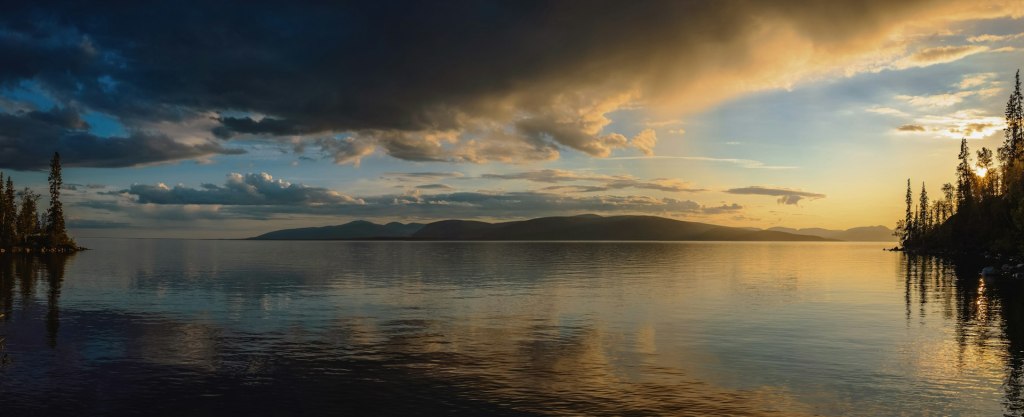
Last Wednesday I drove home from the Northwoods with a truck that smelled like campfire and a feeling I’ve been trying to name ever since.
Here’s what happened, as plainly as I can tell it. Seventeen of us, men and women, builders of companies and firms and practices, drove to Camp Highlands, a boys’ summer camp on Plum Lake in northern Wisconsin that has been running since 1904. The campers had gone home for the season. The directors opened the place to us. For five days we lived in cabins with uneven wood floors, ate at long tables, paddled, portaged, swam, sat on docks, and gathered each morning in a circle around one question.
It was the first Trailhead expedition. I’d been planning it for the better part of a year, and I need to tell you up front that almost everything I planned turned out to be the second most important thing.
What I can’t tell you
Before anything else, a word about what this essay won’t contain.
On the first morning, before the first question, we made each other one promise: what is said in the circle stays in the circle. We repeated it on the last morning, before the drive home. Several people told me afterward that hearing it said out loud, twice, was what made the middle possible.
So you will find no stories here about what anyone shared. Not anonymized, not disguised, not hinted at. The trust in that circle isn’t mine to spend on content. What I can write about is the container itself: the place, the structure, and what I watched it do to a group of people who arrived, as most of us do, wearing a lifetime of competence like a winter coat in August.
The questions
Each morning had one question. Not an agenda. A question.
The first morning: What am I becoming? Not what have you built, not what are your goals. What are you, right now, in the middle of your life, turning into? It’s a question with no professional answer, which is exactly why it works. You can watch people reach for their rehearsed material, the origin story, the lessons learned, and find that none of it fits the question. What’s left when the material fails is the actual person. That’s who we were there to meet.
The second morning: What have I been carrying? We are, all of us, pack animals. Old grief, old grudges, a father’s voice, a failure from fifteen years ago that still runs the show from a back room. The wilderness turns out to be a good place to inventory a load, maybe because everyone there had just carried a literal canoe over a literal portage and knew exactly how weight works. Things get heavier the longer you pretend they’re not there.
The third morning’s question deserves its own essay, and next month I’ll write it. For now I’ll say that it wasn’t the question I’d originally planned, and the revision taught me more about this group of people, and about myself, than anything else in the program.
The part nobody planned
Here’s the finding I keep returning to, and if you take one thing from this dispatch, take this.
The content was good. The questions were honest, the facilitation was skilled, the reading we’d circulated was rich. And all of it, every carefully designed element, was almost secondary.
What actually did the work was the place.
No cell signal. No titles. A lake at dusk that made conversation feel optional and presence feel mandatory. Loons at night. Cold water in the morning. The particular humility of being a beginner in a canoe at fifty-five. Awe, administered in small daily doses, does something that no agenda can do: it makes the self that performs feel suddenly ridiculous, and the self underneath feel suddenly safe.
I watched guards drop in forty-eight hours that I don’t believe would have dropped in forty-eight weeks of conference rooms. Not because anyone was pushed. Because the usual reasons for the guard, the audience, the stakes, the context, had been left in the parking lot three hundred miles south. Immersion did the heavy lifting. The questions just gave the honesty somewhere to land.
The evenings proved the same point from another angle. The schedule for the evenings was deliberately thin, and the thin parts became the heart of the trip. A campfire the first night. A circle where each person told the story of one object they’d brought. A night of songs, badly and joyfully sung. None of it was content. All of it was the point.
The second sunrise
The name of this essay comes from the morning most of us will remember longest.
There is a particular thing that happens on the second or third day of real immersion, and the researchers who study nature and cognition have a name for the neighborhood it lives in, but the lived version is simpler. You wake up and the noise is gone. Not reduced. Gone. You stand on a dock with coffee while the sun comes up over the water, and you realize you are not thinking about anything. You are just watching a sunrise, the way you did when you were ten, before watching a sunrise had to compete with everything else you were supposed to be doing.
Several of us were on that dock. Nobody said much. There wasn’t a deliverable.
I’ve sat through a lot of expensive rooms in my life. I have never seen anything work on people like that sunrise worked on us. Whatever Trailhead becomes, that morning is now its true north: build containers where that can happen, and then have the discipline to get out of the way.
What we learned, for next time
For those of you who build things and want the retro, here it is in brief.
The wilderness is the mechanism, not the backdrop. Every future expedition gets designed from that premise. The logistics serve the immersion, never the reverse.
Precision in the questions matters more than I knew. A question aimed slightly wrong at the wrong group produces performance. Aimed right, it produces truth. More on this next month.
Protect the unplanned hours. The best moments arrived in the gaps. We’ll plan tighter mornings and emptier evenings from here on.
Say the confidentiality promise out loud, every time, at the start and the end. It isn’t a formality. It’s the foundation.
And keep it small. Seventeen was the outer edge of one honest circle.
Afterward, with everyone’s permission, we gathered what people chose to share into a small keepsake for the group. It’s called The Second Sunrise, and it will never be published. Some things are supposed to stay on the dock.
The rest of us came home. The inbox was still there. The firm was still there. But something came back down the highway with each of us, and the work now, the real work, is not letting the noise take it back.
That’s what the forums are for. That’s what this journal is for. The trip ends. The trail doesn’t.
The Trailhead Letter brings each new journal entry to your inbox. Nothing said in a Trailhead circle, and nothing for sale.


Leave a Reply